Welcome, About us

Hello and welcome. My name is Sammy L. Pittman, DVM and I am a veterinarian, farrier, and horsemen with a great interest in the field of equine podiatry. My wife and I own and operate Innovative Equine Podiatry and Veterinary Services in Collinsville TX. My passion lies within the health and well being of the hoof to better serve your equine companion. With so much lameness attributed to the lower limb many horses require an out of the box approach to achieve the success desired.
Give us a call and we will be glad to help you in any way we can. Thanks so much.
I will be discussing different Cases and thoughts from our world with the horse. Feel free to contact us via text or call at 903-718-0056 or send an email to iepvs11@gmail.com. Thank you for reading and enjoy

Tuesday, September 20, 2011

White line disease Cases

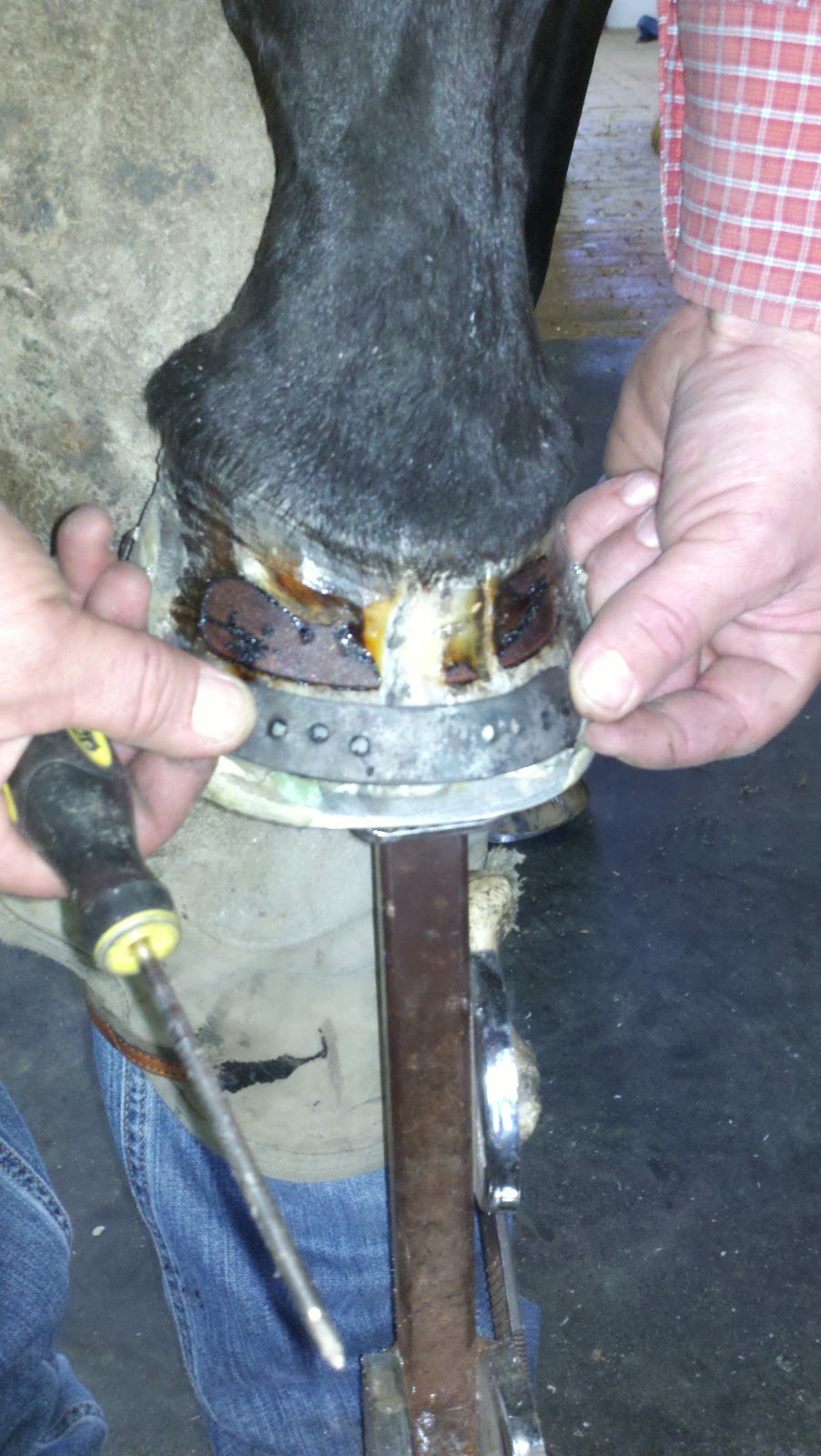
Hello Everyone,  I am attempting to redesign my blog. I am trying to design to have a page for each disease process of the equine hoof.    This is an update to the severe white line disease case I have been working on for the last few months.  Considerable progress has been made noted by good hoof wall growth free of fungal invasion and good sole depth recovery.  The foot has regenerated and is looking more like a foot should.  One area on the lateral (outside) toe of the right front that has not responded and has invaded the new growth.  During this visit I completely removed all horn affected and this is the only spot that I needed to remove part of the new growth.

I was able to get a couple of nails in the heel region but mostly nails are glued to the inner layers of horn wall.  Please look back at the previous months post's to see pictures and radiographs.  After the pictures I wrapped a 3" casting tape for added security but removed any glue or cast material over the Lateral toe site so the owner could clean and treat with keratex hoof hardener, but mostly keep it open to the air.


Monday, August 29, 2011

Backyard mare Project, Updated radiographs after returning to Flat perimeter fit shoes. Please look back at previous Post for serial podiatry style radiographs and venograms

Hello again, I hope this finds you and yours healthy and safe.  Kellee and I have been very busy and enjoying meeting many new clients and horses.   We are now focused on getting ready for Dr. Reddens In depth podiatry clinic in October and hope to see many of you there.  For more information on that go to our website at www.innovativeequinepodiatry.com and click on the Nanric link. 

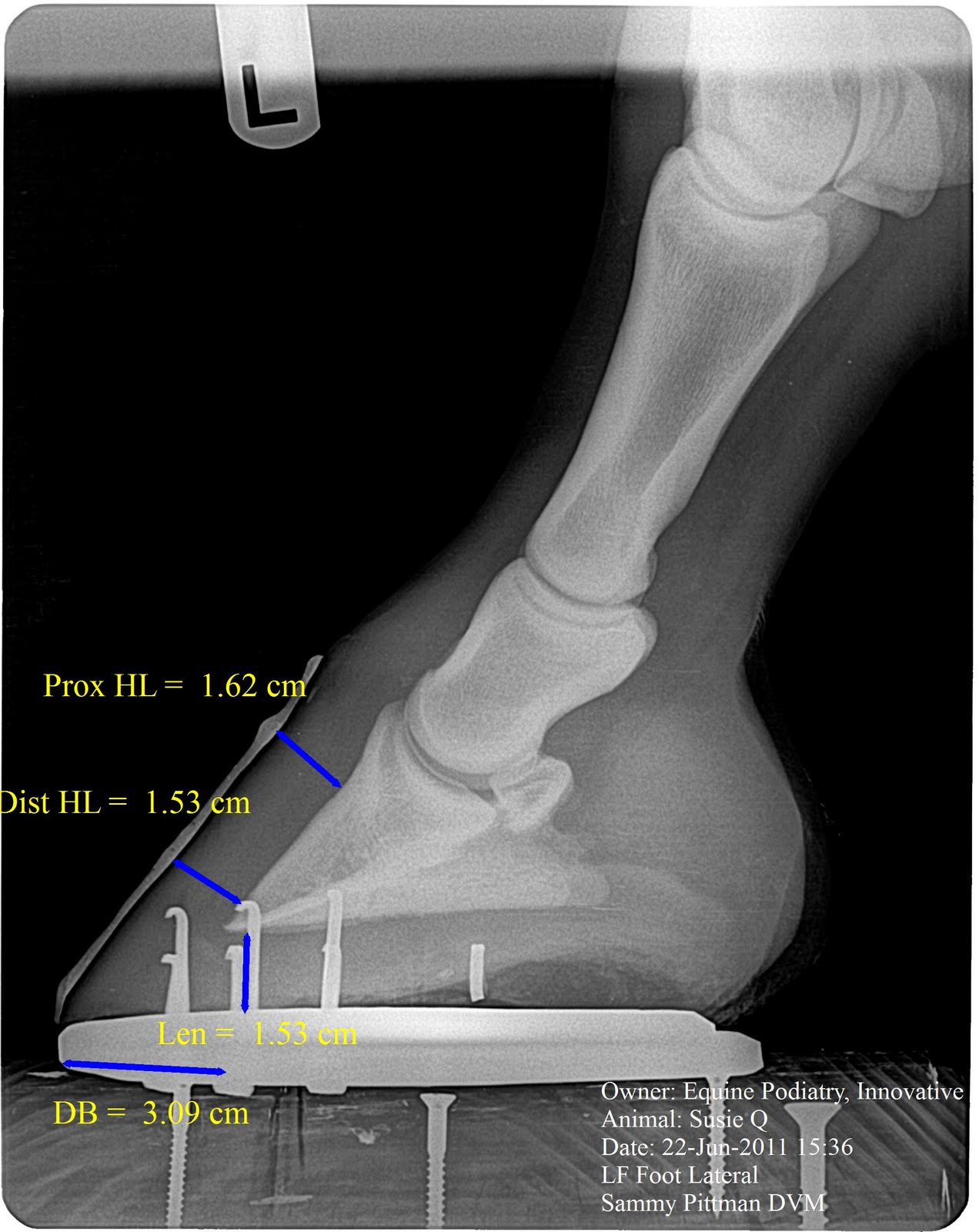
I am posting some radiographs of Susie Q which is my old faithful trail horse that I have placed back into to a more traditional perimeter fit steel shoe after being in a rockered four point shoe and obtaining 19mm of sole depth.  Please look back at the other post that contain the previous radiographs and venograms.  I will post below radiographs from June 20 when the steel flat perimeter fit shoes where applied and today's radiographs.  A good ole 8 week cycle.  She did lose one shoe at 2 weeks in and I replaced.  Note the toe clip on the Left front.  Notice the loss of sole depth in both fronts and gain of nearly 10 mm of digital breakover.  She did grow hoof wall which elevates digit from the shoe but true dense sole depth, measured from the tip of the coffin bone to the noticeable dense sole, is diminished by a few millimeters. 


You would expect an 8 week cycle to have a ton of sole depth but this is where we are wrong many times.  If you take these hooves and reset while cleaning and cupping the sole you may have as little as 10 mm of sole when finished.  If this horse remains in this similar package another 8 weeks and we are lucky and maintain that 10mm of sole we are still below the healthy sole depth of 15 mm required to have a healthy vascular supply and protection noted on the venograms.   Digital breakover has increased almost 10mm.  This had increased the effective lever arm to a whopping 15-20mm past what would be considered ideal of 20-25mm.  The shorter breakover and self adjusting palmar angle is what allowed this mare to obtain better than adequate sole depth of 19mm.

Also notice the decrease in Palmar angle.  This is the reaction to the lengthening digital breakover and the base of support migrating forward allowing more load and crush to the palmar aspect of the hoof. This will overload the digital cushion and deep digital flexor tendon and overwhelm it's capability to suspend the coffin bone at a higher palmar angle.  I believe the deep digital flexor muscle continues to get stretched and has difficulty returning to home base with maximum contraction capability and cannot pull the palmar angle back up to a more positive angle.  The long digital breakover is antagonizing the ability for the flexor muscle be an affective suspension apparatus and hold the better palmar angle.  At the same time with extra antagonism against the flexor tendon we are adding additional compression of the solar corium below the tip of the coffin bone which in turn compresses the blood supply and reduces production of horny sole and the measurable distance from the tip of coffin bone to the cup of the foot which is the black air space between sole and shoe.  It is this response that suggest to me that many horses should not be maintained in traditional perimeter fit shoes but in a package that will at least maintain a better digital breakover longer in the cycle.  This approach obtained through natural balance shoes, mustad equilibrium, kerkhart comforts, four point shoe, or by simply forging a roll in the toe of a plain steel shoe, will allow better maintanence of sole depth, tendon tension, palmar angle and overall health of the entire limb.

 Reducing these forces should also reduce hyperextension forces in fetlock and carpus (fetlock and knee) and may help in reducing arthritic conditions in aged performance horses if started and maintained in this manner early in life.  Podiatry style radiographs early in life will help determine which horses may benefit from shorter digital breakover shoes and aid in maintaining better hoof  and limb health.  Many times shortened digital breakover is only part of the equation to institute better blood supply and foot mass recovery.  I suggest the above as a bare minimum for maintaining a sound horse.  If we are not obtaining the goals we set forth, we must also consider palmar angle adjustment especially in unsound horses with diagnosed lameness issues.  Susie Q is not lame but is beginning to stumble with this long breakover.  I can only surmise that if I where to continue the flat shoeing approach coupled with a performance career for several years that this will lead to certain pain and inflammation in many possible areas. 

I plan to reset the flat steel shoes and continue to monitor over the next 4-6 weeks. 

This is first flat shoe after rocker
8 Weeks in flat shoe, note loss of sole depth and increased digital breakover.

First flat shoe after rockers


8 weeks in flat shoe, note loss of sole depth and very lengthening of digital breakover and loss of palmar angle. 

Monday, August 22, 2011

Pictures from the 5 day Podiatry class with Dr. Ric Redden

Well it was an exciting and educational week spent at Dr. Ric Reddens equine podiatry 201 clinic in Versailles Kentucky.  Attendees where largely international with teams from Switzerland, Germany, Costa Rica, Texas and of course Oklahoma.  Dr. Redden, his wife Nancy and his staff create a hospitable, laid back environment for easy learning.  We had several cases ranging from club feet, acute and chronic laminitis and navicular cases.  Mornings where spent in lecture covering topics with great detail that where relevant to the afternoon cases.  Dr. Amy Rucker of Midwest Equine in Columbia, Mo a long time student of Dr. Redden's, and popular lecturer regarding laminitis treatment and venogram study was also present assisting in the educational process.  It was very exciting to see the world wide interest that Dr. Redden has inspired through his multiple lectures across the world.  I plan to post several pictures in which more information will be in the caption below.  A special thanks to my team members, Frank the German Brendan Frost from Stillwater Ok.  It was a great pleasure meeting everyone and getting to spend valuable time with Dr's Redden and Rucker.  


Large Draft with grade 3 club and white line disease.  Slight rockered flat shoe handmade by the Swiss Team

Grade 3 Club with a toe crack.  We placed a rockered full rocker and a toe band while the foot was unloaded to prevent pinching of underlying laminar tissue.

After class play in Dr Reddens self made log blacksmith shop.

Rockered Rail shoe for a Navicular horse

Frank the German and myself.  This is the first time for Frank to drive a bid Dodge diesel.

Dr. Redden demonstrating his quarter crack lacing technique to Kyle from Texas and Jorge from Costa Rica in Brandon O'neals Purdy Built F3 trailer.

P3 Fracture in a weanling

Walking horse with contracted DDF and SDF and very thin soles.  Rocker rail placement to facilitate better sole mass and comfort
Steffan from Switzerland, European style with an assistant to hold the leg for you.  I tried it and I would have to relearn how to trim and nail!
Rocker rail for navicular case to release deep digital tendon pressure.

Finished rockered full rocker and toe band


Don't miss your chance to learn an in depth approach to many common ailments from Dr. Ric Redden, DVM we all see and deal with this October 14-15 in Tulsa Oklahoma.  For more information contact me a 918*235*1529

Tuesday, July 26, 2011

Lobo the Laminitis case.


Welcome again,  This is a case of acute laminitis that we were called to look at late on the evening of May 29, 2011.  History of colic episodes the previous couple of days but now not wanting to stand and when does stand has typical laminitis stance.  Upon examination normal foot conformation no ridges but large bounding pulses noted in all four feet.  Placed in Nanric modified ultimates which raise the palmar angle 18-20 degrees and Lobo immediately began to show signs of comfort with licking of lips, less distress and standing up squarely on fronts.  He was still reluctant to move in a normal fashion.  Baseline radiographs are taken on this evening and have soft tissue parameters within normal range.  This is where many hoof care professionals are confused as no signs of bone displacement or rotation has occurred, but it is still very important to support this foot mechanincally with wedging to unload effects of the deep digital flexor tendon as the vascular compromise has likely began.  The idea that if there is no rotation it is no laminitis/founder does not hold true. This will also show how important radiographs on day 1 of  exam are so valuable when compared to the next visit 5 days later.  A baseline venogram was not performed as finances where limited at this point.


We returned to visit Lobo five days later and find he has been laying down the biggest part of the time which is probably to his advantage as all load is off feet and better circulation is allowed.  Radiographs on this day show significant soft tissue parameter changes with large increases in CE, H/L zones and decrease in sole depth.  Palpable ledge is noted on both fronts at the coronary band that is consistent with a sinker.  We performed a venogram at this point at no charge to client to further increase our knowledge of this case.  The changes in soft tissue parameters indicative of a moderate sinker are confirmed with the venogram with no perfusion at the coronary waterfall, face of coffin bone and sole under tip of p3.  Note even in this severe case the heels remain great perfusion.  The unloaded view is taken with the limb being held up which gives us an idea of what the perfusion may be while laying down with tendon and foot completely unloaded and some indication of what it would look like with  a tenotomy to completely release any action on the coffin bone. 

The venogram is performed in the modified ultimate which unloads the flexor tendon by 60 percent.  This also serves as a means to evaluate a certain therapeutic package.  If your plan is to restore healthy blood supply then you should be able to prove that the package is going to do that via the venogram.  This venogram suggest that the modified ultimate will not be enough to restore proper blood supply and that further mechanical release via deep digital flexor tenotomy would likely improve the situation as the sharp border of the coffin bone is cutting through the sensitive solar corium and its vital blood supply.  Several methods to prevent the bone from displacing are practiced but few have been confirmed and followed with serial venograms and radiographs to prove that they are unloading the circumflex artery.  The heart bar shoe is a positive force applied to the frog in order to antagonize the displacement of the coffin bone, but think about the tissue between the rigid heart bar and the coffin bone.  The solar corium with its blood supply that makes the horny sole that we can see and touch.  Obviously it has helped many cases but I think a further study as to it's affects on foot perfusion in a laminitis scenerio via serial venograms and radiographs is warranted.  Below is the radiographs and venograms from the second visit 5 days later.  I will also post a normal venogram for comparison.
NORMAL VENOGRAM FOR COMPARISON TO LOBO'S


We were unable to perform suggested derotation and tenotomy as financial constraints did exist.  Owner opted to give Lobo more time as he was laying down which is protecting the vital blood supply.  Contact was  made with owner approximately 6 weeks after second visit and Lobo was not improving and he was ready to euthanize and I offered to take Lobo to further his treatment and if not able to be successful I would humanely euthanize if needed.  Lobo was transported to IEPVS and new radiographs and venograms performed.  Notable hoof wall growth had occured and was surprisingly very close to even from toe to heel.  Moderate improvement in venograms in areas of the coronary band, face of p3 and tip of p3.  Considerable displacement of the circumflex still exist and very severe compression of vascular bed under apex of p3 is still present.  Note the changes in the soft tissue parameters on the lateral films.  Note the lucent zone that indicates the level of separation of the horn/lamellar zone.  Despite improvement of venogram, more mechanical release in the area of the circumflex  and solar vascular bed is need and derotational shoeing and tenotomy was performed.  Note the red line is the trim line and guide for shoe placement.  The shoe is a 5 degree rail shoe with a trailer welded in to prevent the toe from tipping up after DDF tenotomy.  The shoe is placed at zero palmar angle with a minimum of 20 mm space below p3 and the 5 degree helps prevent painful subluxation of the coffin joint.  This shoe is atraumatically applied with adhesive and nylon strips.  Two part silicon rubber is used to prop shoe up and apply caudal solar weight distribution.


POST TENOTOMY RADIOGRAPH

TENOTOMY RAIL SHOE, POST TENOTOMY RADIOGRAPH

Lobo has went from laying down 90 percent of the time to standing 90 percent of the time.  Attitude and appetite have greatly improved.  The plan is to recheck venogram and lateral radiographs in 2-3 weeks after tenotomy.  I will gladly post those so we can all learn from this case.  With the amount of bone remodeling that has already occurred to the fragile thin rim of coffin bone it is less likely we will have as good of a response as we would have if derotational shoeing and tenotomy where performed in the important window of opportunity at the second visit.  However, I do expect a great improvement in the hoof growth and patient comfort.  The amount of bone resorption will be what prevents Lobo from returning to a previous level of perfomance.  We will have to wait and see.

I would like to thank my Lovely wife for helping and enduring the  many crippled horses I drag to home to try to fix and learn from.  It is vital to my education to have cases like this. I would also like to thank Brendan Frost for donating a Sunday afternoon to help me shoe Lobo.

Stay tuned for more exciting podiatry cases!!!!!!!!!!!!!!!!!!!!!!!!!!!!!!!!!!!!!!!!!!!!!!!!!!!!

Sunday, July 24, 2011

Follow up on the Severe White line Disease case 7/22/2011

Hope everyone is staying safe in this record warm weather here in the US.  For those of you not suffering from the heat, your lucky.  Well the horses don't care how warm it is they still need there hoof care!  I revisited the white line disease case this past Friday.  We have continued accelerated hoof wall growth without cracks.  The Right front which is the more upright still has signs of fungal invasion despite mechanical unloading noted by the lucent zone in the Horn component of the H/L zone.  This would likely suggest the pathogen is invading new growth.  Left front shows continued improvement in all aspects with good hoof wall growth and sole depth recovery.  Sole growth has been slow to recover but is measurably increasing at this point.  I feel that higher scale mechanics (ie more rocker or deep digital tendon release) will be required for continued success in the right front due to this being the more upright foot and is under more deep digital flexor muscle pull.  At the last visit I instructed the owner to place on a weight control program with only enough alfalfa pellets to get the 100mg biotin and vitamin and minerals in.  Significant weight loss has occurred and will help the overall success of this case as the obesity could increase insulin and decrease the amount of circulation to the lower limbs further decreasing hoof quality and quality.  A great improvement is noted in hoof structure with loss of flares and a tighter new growth coming down.
    I elected to remove more dorsal hoof wall in area's that cavities existed and pack with a mixture of pine tar and oakum versus cleaning and packing with white lighting gel.  Below are updated photos and radiographs.  Read the captions for further information regarding individual images.
Increased sole depth but lesions from fungal invasion have remained

Very first radiographs
Good improvement in sole depth and new growth without fungal invasion


right front with 1/3 of new hoof growth.

Left front with almost half of new hoof growth without cracks.


Shoes are attached with a few nails into hoof wall then 3-4 next to hoof wall and superfast adhesive is used to glue  nails to hoof wall.  A band of superfast is added across the front to attach the two sides.  This has been one of my tougher cases and I appreciate the opportunity to work on this difficult case and the commitment the Owner has made to her equine companion.  We still have several months to go but I feel we have made significant improvement.


    We have two cases in the barn right now that we have been working with and plan to post them here on the blog as soon as time will allow to put together all the images, time lines and thought processes.  One is a fractured second phalanx (short pastern) named Lila that is recovering nicely and the second is a newly acquired laminitis case that was acutely laminitic about 6 weeks ago.  We will be posting those soon so keep checking back.  I am also excited about attending Dr. Redden's In depth podiatry 201 course August 8-12 in Versailles, Ky with farrier and friend Brendan Frost.

CHECK OUT WWW.HEARTLANDHORSE.COM FOR THE ONLINE VERSION OF THE HEARTLAND HORSE TRADER FOR MY FIRST ARTICLE EVER PUBLISHED!!  Look for it in all your local feed stores, tack shops and shows.

Stay cool, but most importantly Stay Fresh,,,,in your knowledge.

Tuesday, June 28, 2011

Backyard mare project update with venograms

Well it has been a while since we looked in on our backyard mare project.  We found some time to radiograph and update her venogram.  She has grown to a little over 17mm of sole depth and a notable return in solar papillae.  She has just been in the rockered 4pt shoe and maintained on pasture and trailriding.  I have placed her back in a more traditional flat steel shoe and placed in a fashion that would commonly be applied.  I theorize that this breakover is too long even on the day I placed it and will be growing ever longer throughout the shoe cycle.  The flat shoe will once again solidly engage the deep digital flexor tendon in which will begin to compress the solar corium and decrease sole depth over the next 2-3 months.  We will continue to radiograph and follow to see what happens.  
Very first venogram 3 1/2 months ago, for comparision


Note the return of the solar papillae with added foot mass.  This is the reason that Dr. Redden  claims 15mm is an adequate sole depth, as is requires 15mm to have a normal healthy venogram with good vascular depth and these papillae.  There is a peculiar absence of contrast that is there from an unknown cause, maybe an abscess brewing creating internal pressure, pushing the contrast out????
Very first raidograph, note the very thin soles.  

Here is a shot just before the removal of the shoe and venogram.  Note the massive increase in sole depth since we began.

Here is a shot after venogram and I placed her in a more common flat steel shoe in a manner in which I would have placed prior to a changing of my mind of how forces interact in the foot.  The DB (digital breakover) is 30 mm. This will continue to lengthen over time and reaching a likely 40-45mm by the next shoeing cycle, possibly.  I also surmise that a gradual reduction in sole depth will also occur due to the long and every increasing DB and increasing forces from ddf on solar corium and dorsal hoof    decreasing the circulation.
solar shot of flat steel shoe.

lateral view of flat steel shoe.  For those of you who know me, know that this was very difficult for me to do.  HEHEHEHEHEHe
Keep checking back for further updates on all our cases and a new one still to come is project Lilla.  She is recovering nicely from a fractured short pastern bone.  I will post here case study as soon as time will allow.  Please feel free to contact us here in Tulsa, Ok via text/call at 918.235.1529 or email at innovativeequinepodiatry@hotmail.com.

We are getting prepared for several upcoming events such as:  July 9th a reduced cost coggins clinic at animal health supply in Tulsa Ok, Aug 8-12th Dr. Redden's 201 podiatry course at International Equine podiatry center in Versailles Ky, 1-2 local demonstrations of radiological and external exam of the hoof and soft tissue parameter measurements, and of course the In depth podiatry lecture and demo with Dr. Redden here in Tulsa October 14th and 15th.

We thank you all for your support.